







The Battle of Puebla Defines the True Meaning of Mexico’s Cinco de Mayo
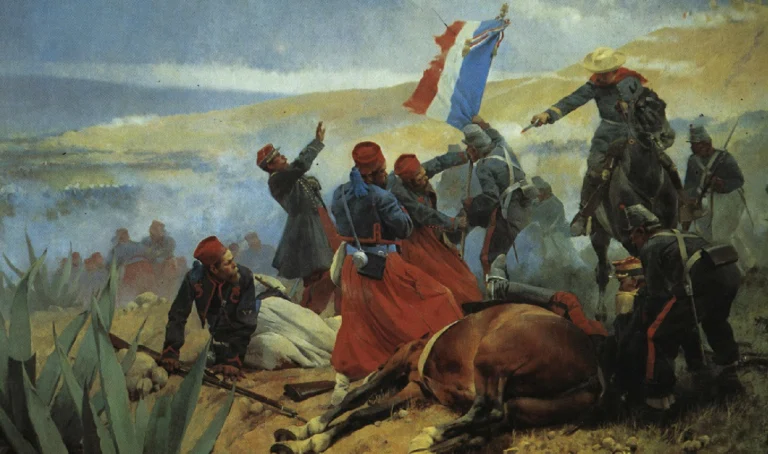
Painting depicting the Battle of Puebla. Photo: UNAM Global
May 6, 2026 Hour: 2:13 pm
🔗 Comparte este artículo
This celebration has become a symbol of the Mexican resilience in the face of foreign intervention.
The “Cinco de Mayo” is widely recognized as a significant cultural and historical holiday in Mexico. It commemorates the Battle of Puebla, which took place on May 5, 1862, when the Mexican army, significantly outnumbered, successfully defended the city of Puebla against the invading forces of the French Empire.
RELATED:
Sheinbaum Criticizes Ayuso for Glorifying the Spanish Conquest
While it is a common misconception that Cinco de Mayo is Mexico’s Independence Day, which actually occurs on September 16, the Battle of Puebla remains a vital moment in the nation’s history.
This period was characterized by significant external threats from European powers seeking to expand their influence in the Americas. To comprehend the true history of 5 May, it is necessary to focus on the story of national resilience and the defense of sovereignty.
Learning about the Battle of Puebla helps explain why this day has become a symbol of pride. It was not merely a military victory; it was a defining moment that captured the essence of Mexican resilience in the face of foreign intervention.
The Battle of Puebla: A Defiance of Imperial Power
Triggered by a severe financial crisis in Mexico. In 1861, President Benito Juárez was compelled to suspend interest payments on foreign debts owed to countries including France, Great Britain, and Spain.
Following negotiations, Britain and Spain withdrew their forces. However, Napoleon III of France saw an opportunity to establish a French-controlled monarchy in Mexico. This strategic maneuver was designed to balance the influence of the United States and augment France’s standing in the Western Hemisphere.
In early 1862, a well-equipped French army landed in Veracruz and began its advance toward Mexico City. At that time, the French military was widely regarded as one of the most elite and powerful forces in the world, having successfully avoided defeat in a major battle for decades.
On 5 May 1862, General Ignacio Zaragoza led a force of approximately 2,000 Mexican soldiers and local volunteers against 6,000 professional French troops. Despite being outnumbered and outgunned, the Mexican forces held their ground.
Following a day of intense fighting and three failed French charges, the invaders were forced to retreat. While this victory did not bring an end to the war, as the French would eventually return with more reinforcements, it became a powerful symbol of Mexican resistance against imperial rule.
The International Impact: Connection to the American Civil War
The Battle of Puebla had significant geopolitical consequences extending beyond Mexico’s borders, particularly affecting the United States. In 1862, the U.S. was in the midst of the American Civil War.
It has been noted by historians that the French intervention in Mexico was partly motivated by a desire to support the Confederacy. By establishing a puppet regime in Mexico, Napoleon III aimed to ensure a reliable supply of cotton for French textile mills and establish a strategic base to provide the Confederate states with weapons and resources.
By successfully overcoming the French forces at Puebla, the Mexican army managed to delay the French occupation of Mexico City by a year. This delay proved to be pivotal, as it prevented the French from providing immediate assistance to the Confederate army during a critical period of the Civil War. Had the French been successful in 1862, the additional support for the South may well have changed the course of the American conflict.
Consequently, the first celebrations of Cinco de Mayo in the United States were not organized by tourists, but by Mexican miners and workers in California who were supporters of the Union and the Mexican Republic.
For these communities, the news of the victory at Puebla was a reason to celebrate the triumph of democracy over monarchy and the fight against the institution of slavery. The historical connection between Cinco de Mayo and the broader North American freedom struggle is well-established, underscoring the holiday’s deep roots in regional history.
Internal Conflict: The Struggle for Mexican Sovereignty
While the Battle of Puebla was a military success, it also highlighted the deep political divisions within Mexico during the 19th century. The conflict was not just between Mexico and France; it was also a struggle between two internal factions: the Liberals and the Conservatives.
The Liberal government, led by Benito Juárez, sought to modernize the country, reduce the power of the church, and protect national sovereignty. Conversely, many members of the Mexican Conservative elite expressed support for the French intervention.
The Conservatives believed that a European-style monarchy would bring stability to Mexico after years of civil unrest. They engaged in active collaboration with Napoleon III to extend an invitation to Archduke Maximilian of Austria, encouraging him to assume the role of Emperor of Mexico.
Following the eventual fall of Mexico City in 1863, Maximilian was installed as the head of the Second Mexican Empire. This period was characterized by a persistent guerrilla war, as Juárez and his supporters refused to recognize the foreign-imposed government.
In the end, the French occupation was not viable in the long term. Following the conclusion of the Civil War and rising tensions in Europe, Napoleon III was compelled to withdraw his troops in 1867 in response to mounting pressure from the United States.
The Chicano Movement: Evolution of the Holiday in the U.S.
The modern prominence of Cinco de Mayo in the United States is largely due to the Chicano Movement of the 1960s and 1970s. During this era, Mexican-American activists sought to build a distinct identity that celebrated their indigenous and Mexican roots while fighting for civil rights.
The Battle of Puebla was regarded as a potent emblem of resilience. To these activists, the victory of a marginalized Mexican force over a global superpower reflected their own struggle against systemic inequality and discrimination in the U.S.
By promoting Cinco de Mayo, the Chicano Movement transformed a historical military date into a cultural platform. It became an opportunity to celebrate ethnic pride and raise awareness of the significant contributions of Mexican-Americans to the nation’s history.
Schools, community centers and university student groups began organizing events with the emphasis on the message of self-determination. For many, the holiday served as a tool for political mobilization and a means to demand better labor conditions and educational opportunities.
The Lasting Legacy of May 5
To summarize, Cinco de Mayo is a complex date that can be interpreted in different ways depending on the context. In Mexico, specifically in the state of Puebla, it is a solemn commemoration of a significant military achievement that defended the nation’s independence against European imperialism.
It is a poignant reminder that the country’s sovereignty was forged through the courageous resistance of its citizens, who courageously stood against both foreign intervention and internal betrayal.
In the United States, the holiday has evolved from a nineteenth-century show of solidarity with the Union into a modern cultural phenomenon. While the commercial version of the day often overlooks the details of the Battle of Puebla, the holiday’s roots remain tied to the concepts of civil rights and cultural identity. It provides an annual opportunity to reflect on the shared history of North America and the enduring connections between Mexican and American societies.
It is imperative to acknowledge the true history of May 5 to foster a more respectful and accurate appreciation of the day. By examining the issue from a different perspective, we gain a deeper understanding of the resilience of the people, their historical rejection of colonial rule, and their ongoing aspiration to shape their own destiny.
Sources: teleSUR – EDUCBA – Library of Mexican Congress – Britannica – CNN – Gob Mx
Author: Silvana Solano
Source: teleSUR